SHADOW DRIVE
Ever wonder if a battery could make an air-cooled 911 feel more alive? Vonnen’s Shadow Drive adds a slim 120-hp electric motor to Porsches, delivering a hybrid performance boost while preserving the car’s analog feel.
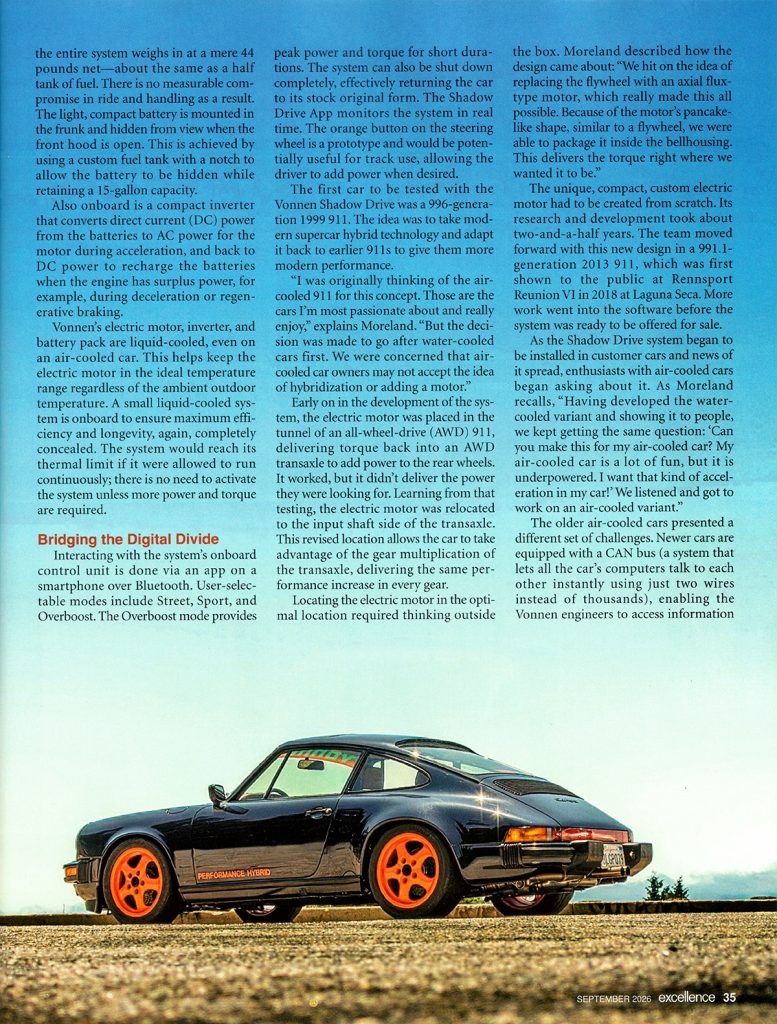
“I see the car has ‘Performance Hybrid’ spelled out on the door. How exactly does it work?” I asked. “Let’s go for a drive, and I’ll show you,” the man said.
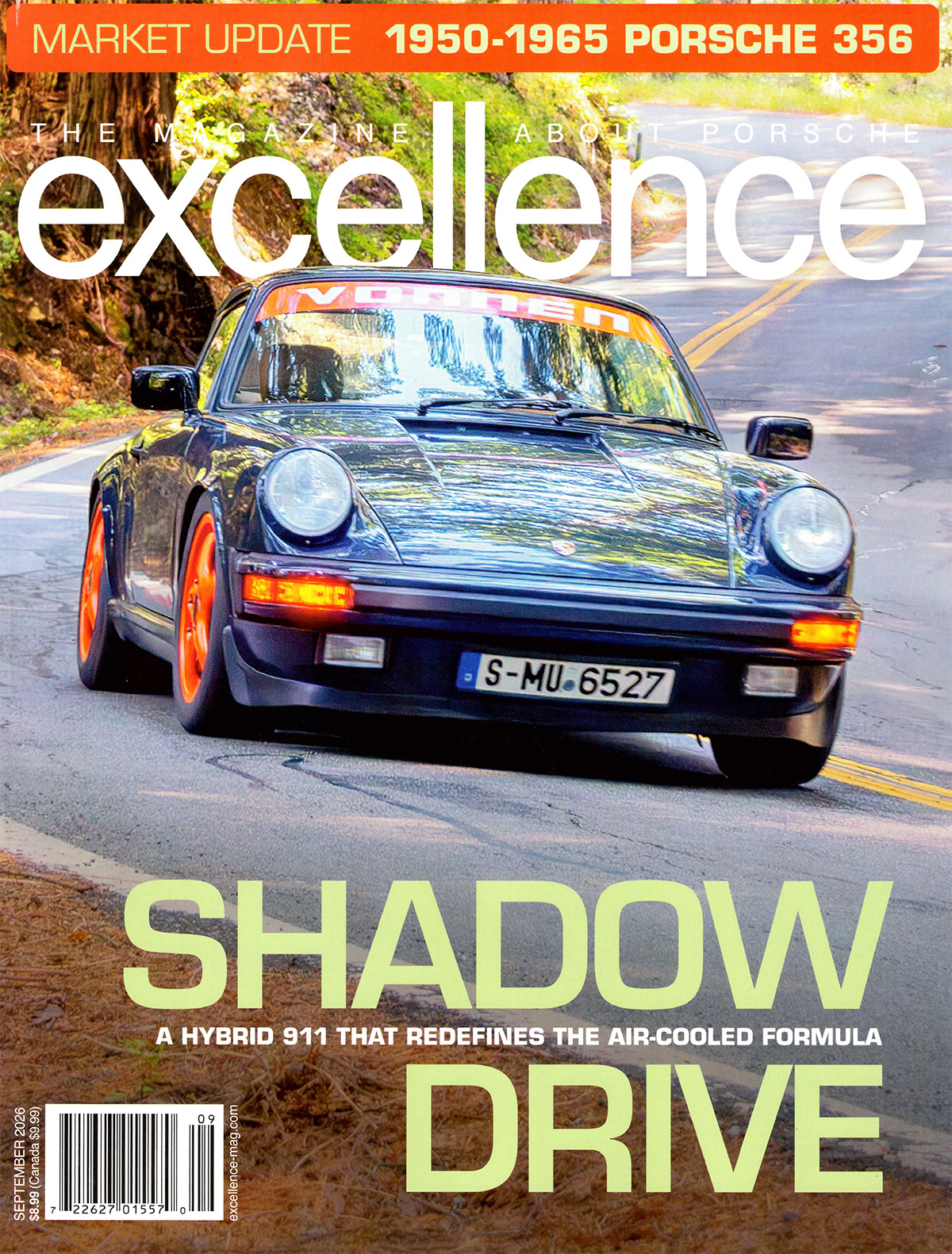
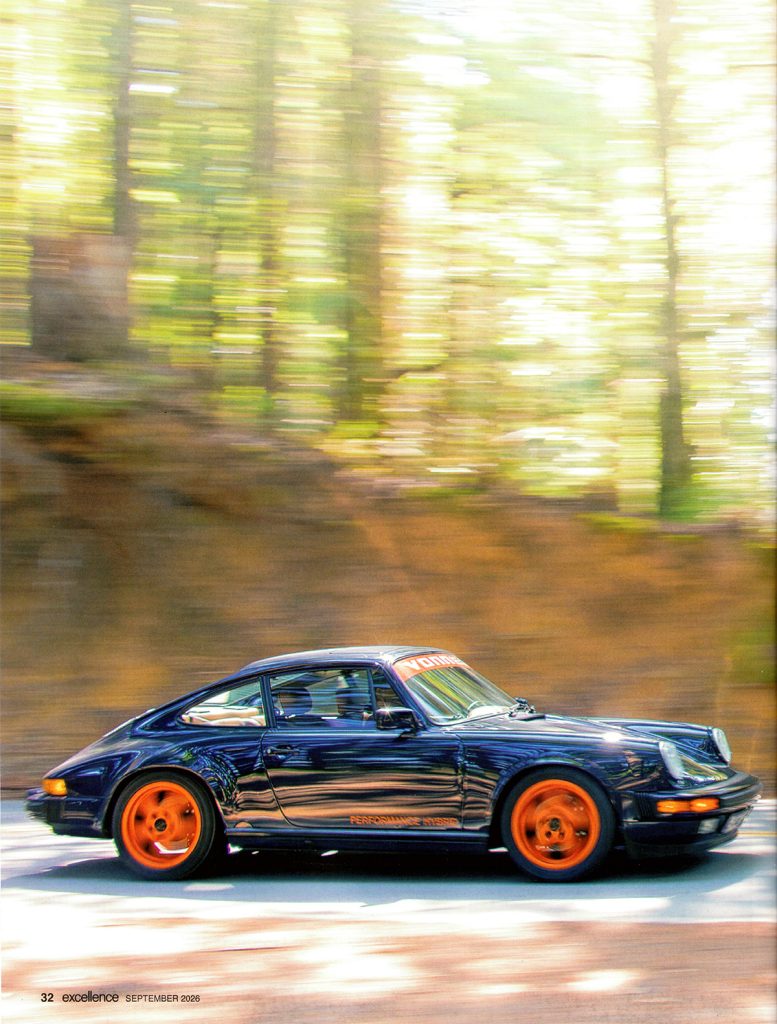
The car is a 1988 Porsche 911 Carrera 3.2, and the man is Chuck Moreland, the president of Vonnen. In the right mode, this mostly unassuming sports car can seamlessly unleash over 120 horsepower and about the same amount of torque instantaneously. It feels practically like a Navy fighter pilot being launched off an aircraft carrier when engaged.
Moreland has been on a mission to improve the performance capabilities of Porsche cars since he started Elephant Racing in 2002. He and his team in Santa Clara, California, have designed and manufactured engine and suspension parts with an attention to quality and detail
that is well recognized and respected in the Porsche community. Many Elephant Racing parts have been on the cars featured in this magazine over the years.
Not ready to rest on the laurels of his hard-earned success, Moreland wanted to push the envelope of Porsche performance further. Electric power was the way he chose. Not by creating an all-electric car, but by adding an electric motor to an existing car to create a hybrid. Not a quiet, gas-sipping, docile car for suburbanites. He wanted the car to feel and sound like a Porsche, but with a lot more power. His quest for more power led to the creation of Vonnen’s Shadow Drive.
The Anatomy of Shadow Drive Shadow Drive is a three-phase alternating current (AC) motor that can also operate efficiently as a generator. Generator mode recharges the Shadow Drive battery and can charge it anytime the engine is running. It can also provide counter-torque through the drivetrain (similar to engine braking) and thereby enable regenerative braking, recapturing energy into the battery that would otherwise be lost to heat in the brakes.
At the heart of the Shadow Drive system is an electric motor that replaces the flywheel. The part is thin enough (about 3.0 inches) to fit inside the bellhousing, as the company points out on its website, like a pizza box. Bill Davis, Vice President of Engineering at Vonnen, has an engine and transaxle on a display stand in the shop that allows one to see how it fits.
It is virtually impossible to see the Shadow Drive setup when it is fitted in a car, as it adds just under an inch to the drivetrain length, which is part of the allure. Davis had many years of experience working in the EV industry beforejoining Vonnen to help perfect the
Shadow Drive. A mounting bracket modification relocates the transaxle slightly to allow the slim electric motor to fit without altering anything else in the drivetrain.
Additionally, a small battery is mounted onboard. Optimized for rapid bursts of power as opposed to maximizing driving range, Shadow Drive’s battery is much lighter and more compact than those found in traditional EVs. As a result, the entire system weighs in at a mere 44 pounds net—about the same as a half tank of fuel. There is no measurable compromise in ride and handling as a result.
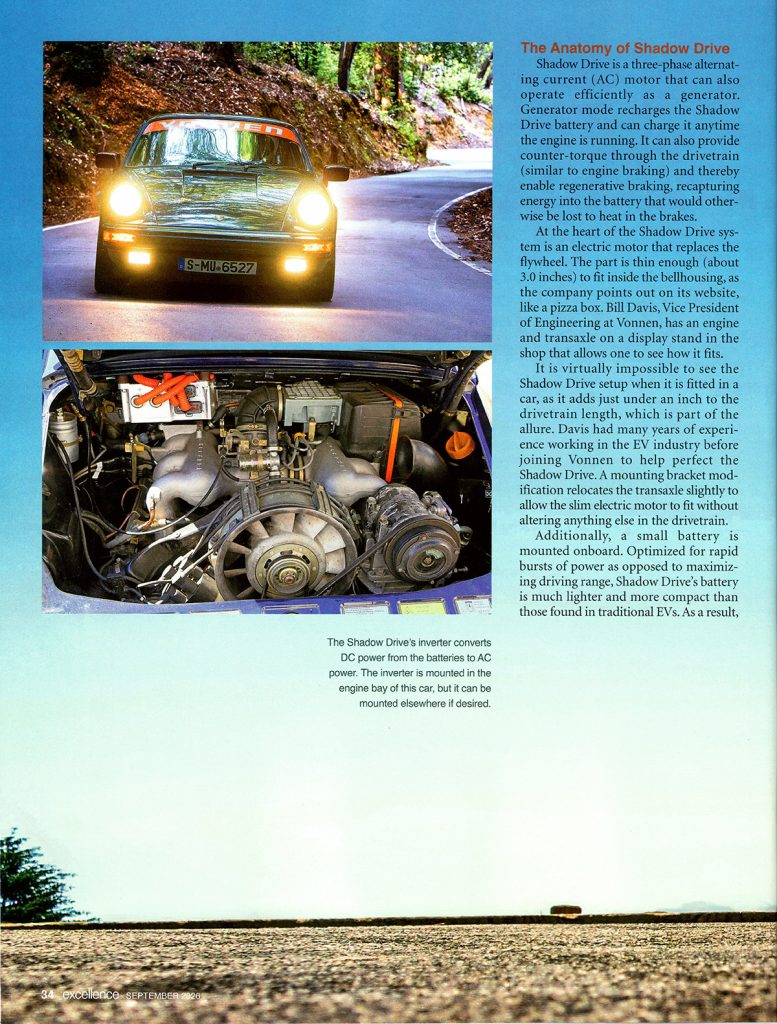
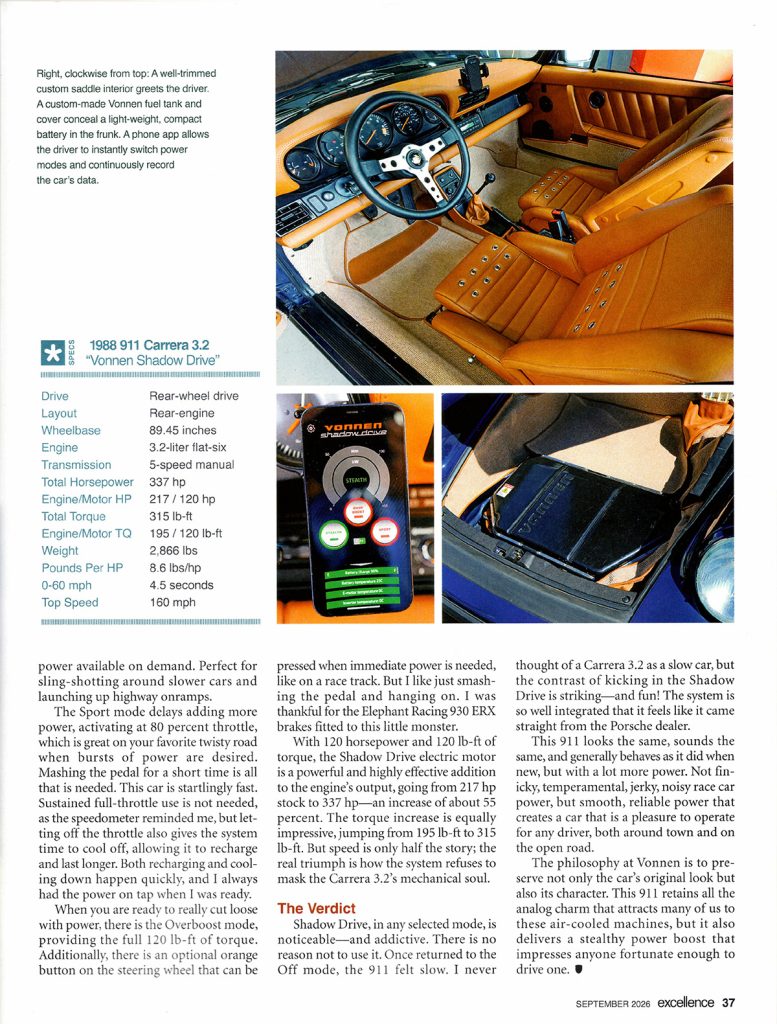
The light, compact battery is mounted in the frunk and hidden from view when the front hood is open. This is achieved by using a custom fuel tank with a notch to allow the battery to be hidden while retaining a 15-gallon capacity.
Also onboard is a compact inverter that converts direct current (DC) power from the batteries to AC power for the motor during acceleration, and back to DC power to recharge the batteries when the engine has surplus power, for example, during deceleration or regenerative braking.
Vonnen’s electric motor, inverter, and battery pack are liquid-cooled, even on an air-cooled car. This helps keep the
electric motor in the ideal temperature range regardless of the ambient outdoor temperature. A small liquid-cooled system is onboard to ensure maximum efficiency and longevity, again, completely concealed. The system would reach its thermal limit if it were allowed to run
continuously; there is no need to activate the system unless more power and torque are required.
Bridging the Digital Divide
Interacting with the system’s onboard control unit is done via an app on a smartphone over Bluetooth. User-selectable modes include Street, Sport, and Overboost. The Overboost mode provides peak power and torque for short durations. The system can also be shut down completely, effectively returning the car to its stock original form. The Shadow Drive App monitors the system in real time. The orange button on the steering wheel is a prototype and would be potentially useful for track use, allowing the driver to add power when desired.
The first car to be tested with the Vonnen Shadow Drive was a 996-generation 1999 911. The idea was to take modern
supercar hybrid technology and adapt it back to earlier 911s to give them more modern performance.
“I was originally thinking of the aircooled 911 for this concept. Those are the cars I’m most passionate about and really enjoy,” explains Moreland. “But the decision was made to go after water-cooled cars first. We were concerned that aircooled car owners may not accept the idea of hybridization or adding a motor.” Early on in the development of the system, the electric motor was placed in the tunnel of an all-wheel-drive (AWD) 911, delivering torque back into an AWD transaxle to add power to the rear wheels. It worked, but it didn’t deliver the power they were looking for. Learning from that testing, the electric motor was relocated to the input shaft side of the transaxle. This revised location allows the car to take advantage of the gear multiplication of the transaxle, delivering the same performance increase in every gear.
Locating the electric motor in the optimal location required thinking outside the box. Moreland described how the design came about: “We hit on the idea of replacing the flywheel with an axial fluxtype motor, which really made this all possible. Because of the motor’s pancakelike shape, similar to a flywheel, we were able to package it inside the bellhousing. This delivers the torque right where we wanted it to be.”
The unique, compact, custom electric motor had to be created from scratch. Its research and development took about two-and-a-half years. The team moved forward with this new design in a 991.1-generation 2013 911, which was first shown to the public at Rennsport
Reunion VI in 2018 at Laguna Seca. More work went into the software before the system was ready to be offered for sale.
As the Shadow Drive system began to be installed in customer cars and news of it spread, enthusiasts with air-cooled cars began asking about it. As Moreland recalls, “Having developed the watercooled variant and showing it to people, we kept getting the same question: ‘Can
you make this for my air-cooled car? My air-cooled car is a lot of fun, but it is underpowered. I want that kind of acceleration in my car!’ We listened and got to work on an air-cooled variant.”
The older air-cooled cars presented a different set of challenges. Newer cars are equipped with a CAN bus (a system that lets all the car’s computers talk to each other instantly using just two wires instead of thousands), enabling the Vonnen engineers to access information the engine, transmission, brakes, and everything else onboard the car and intercept those messages.
Critical data, such as throttle position and gear selection, were most useful in developing the water-cooled car’s design. Moving forward, the Vonnen team instrumented the air-cooled car with specialized sensors to gather the data needed for itsshadowing. The Shadow Drive needs to see what the car is doing in real time so it can apportion power assist and regeneration at the appropriate times and in the
appropriate amounts.
The system in the air-cooled cars is basically the same as the one used in the newer cars, using the same technology and algorithms, but modified to work on the older cars. Some parts and details are completely different, including the bell housing diameter and bolt pattern. In the end, they developed a completely new custom motor designed specifically for air-cooled fitment. The process took another two years to perfect.
The Vonnen motor for air-cooled cars weighs about 35 pounds, which is fully offset by the items removed. Absent are the original flywheel, starter ring gear, and factory starter motor (which are very heavy in air-cooled cars). Conveniently, this removed weight comes from the same location where the electric motor is inserted—minimizing impact on weight bias. The Shadow Drive motor also takes over engine starting duties and has the engine running almost instantly after turning the ignition key.
Behind the Wheel
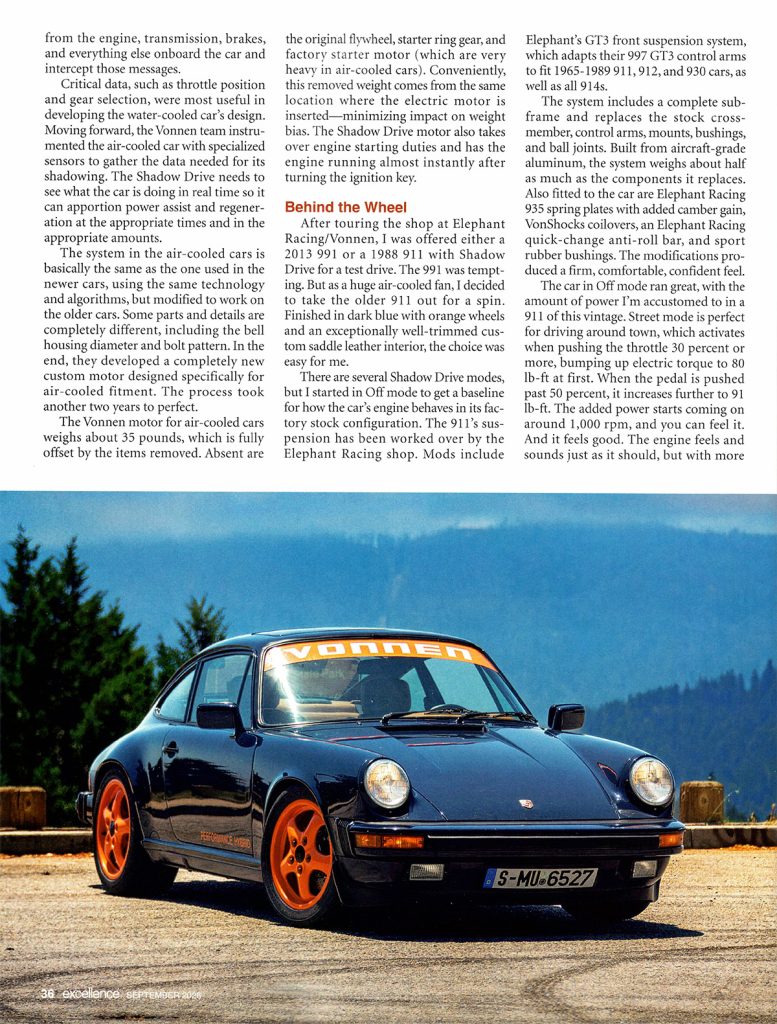
After touring the shop at Elephant Racing/Vonnen, I was offered either a 2013 991 or a 1988 911 with Shadow Drive for a test drive. The 991 was tempting. But as a huge air-cooled fan, I decided to take the older 911 out for a spin. Finished in dark blue with orange wheels and an exceptionally well-trimmed custom saddle leather interior, the choice was easy for me.
There are several Shadow Drive modes, but I started in Off mode to get a baseline for how the car’s engine behaves in its factory stock configuration. The 911’s suspension has been worked over by the Elephant Racing shop. Mods include Elephant’s GT3 front suspension system, which adapts their 997 GT3 control arms to fit 1965-1989 911, 912, and 930 cars, as well as all 914s.
The system includes a complete subframe and replaces the stock crossmember, control arms, mounts, bushings, and ball joints. Built from aircraft-grade aluminum, the system weighs about half as much as the components it replaces. Also fitted to the car are Elephant Racing 935 spring plates with added camber gain, VonShocks coilovers, an Elephant Racing quick-change anti-roll bar, and sport rubber bushings. The modifications produced a firm, comfortable, confident feel.
The car in Off mode ran great, with the amount of power I’m accustomed to in a 911 of this vintage. Street mode is perfect for driving around town, which activates when pushing the throttle 30 percent or more, bumping up electric torque to 80 lb-ft at first. When the pedal is pushed past 50 percent, it increases further to 91 lb-ft. The added power starts coming on around 1,000 rpm, and you can feel it. And it feels good. The engine feels and sounds just as it should, but with more power available on demand. Perfect for sling-shotting around slower cars and launching up highway onramps.
The Sport mode delays adding more power, activating at 80 percent throttle, which is great on your favorite twisty road when bursts of power are desired.
Mashing the pedal for a short time is all that is needed. This car is startlingly fast. Sustained full-throttle use is not needed, as the speedometer reminded me, but letting off the throttle also gives the system time to cool off, allowing it to recharge and last longer. Both recharging and cooling down happen quickly, and I always had the power on tap when I was ready. When you are ready to really cut loose with power, there is the Overboost mode, providing the full 120 lb-ft of torque. Additionally, there is an optional orange button on the steering wheel that can be pressed when immediate power is needed, like on a race track. But I like just smashing the pedal and hanging on. I was thankful for the Elephant Racing 930 ERX brakes fitted to this little monster. With 120 horsepower and 120 lb-ft of torque, the Shadow Drive electric motor is a powerful and highly effective addition to the engine’s output, going from 217 hp stock to 337 hp—an increase of about 55 percent. The torque increase is equally impressive, jumping from 195 lb-ft to 315 lb-ft. But speed is only half the story; the real triumph is how the system refuses to mask the Carrera 3.2’s mechanical soul.
The Verdict
Shadow Drive, in any selected mode, is noticeable — and addictive. There is no reason not to use it. Once returned to the Off mode, the 911 felt slow. I never thought of a Carrera 3.2 as a slow car, but the contrast of kicking in the Shadow Drive is striking—and fun! The system is so well integrated that it feels like it came straight from the Porsche dealer.
This 911 looks the same, sounds the same, and generally behaves as it did when new, but with a lot more power. Not finicky, temperamental, jerky, noisy race car power, but smooth, reliable power that creates a car that is a pleasure to operate for any driver, both around town and on the open road.
The philosophy at Vonnen is to preserve not only the car’s original look but also its character. This 911 retains all the analog charm that attracts many of us to these air-cooled machines, but it also delivers a stealthy power boost that impresses anyone fortunate enough to drive one.